
Information Portal for Immigrants
Learn about the different Information Portals for Immigrants
The Welcome area is AESCO’s first point of contact. We provide initial guidance, information and support to migrants and their families, taking into account their personal, social and administrative situation. Our aim is to facilitate access to rights, resources and basic services, through close, respectful support tailored to each individual situation, helping to ensure dignified, gradual integration into society.
How can we guide you?
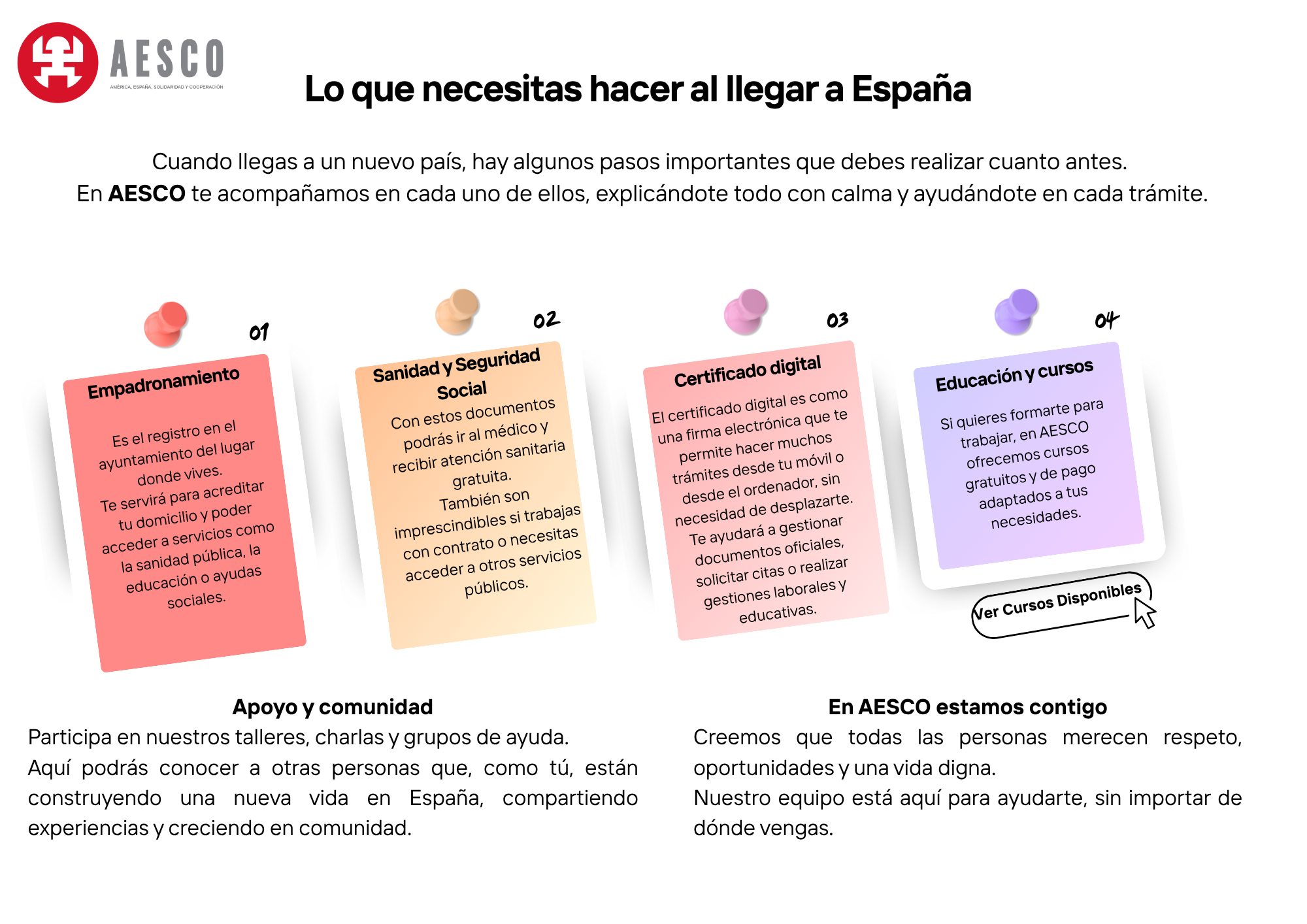
Practical information on rights, resources and services for migrants and their families
Guide prepared using resources from the Community of Madrid. For information tailored to other cities, please contact the nearest AESCO office.
If you would like to learn about the resources available in your city, select one of the offices listed below: Madrid, Valencia or Barcelona. There you can access the information and services specific to each location.



Regularisation
Below are the different types of residence authorisation on exceptional grounds (arraigo) that allow foreign nationals to regularise their status after meeting certain requirements related to length of stay, integration or ties in Spain.

Social ties (arraigo social)
Social ties (arraigo social): Allows temporary residence for those who can prove a prolonged stay in Spain, family ties or social integration.
Employment ties (arraigo laboral)
Employment ties (arraigo laboral): Also currently known as “socio-employment ties (arraigo sociolaboral)”, aimed at those who have worked for at least a certain period and can prove they have been living in Spain.
Family ties (arraigo familiar)
Family ties (arraigo familiar): For those who have family ties with legal residents in Spain (for example, parents/children).
Training ties (arraigo formación)
Training ties (arraigo para la formación) (updated as “socio-training ties (arraigo socioformativo)”): Allows temporary residence for those who commit to undertaking training, with new measures to make it easier to combine work and study.
Living in Spain
In this section you can download the official application forms required to start different immigration procedures, as well as other guidance forms for making communications with the Administration.
If you are an applicant for asylum, subsidiary protection or temporary protection, you do not need to apply for any of these authorisations. In that case, you must contact the Asylum and Refuge Office via the following external link.

Asylum and Refuge
In Spain, the Spanish Commission for Refugee Aid (CEAR) and other partner organisations provide guidance, legal support and social assistance to people applying for asylum, subsidiary protection or refugee status.
These organisations work in coordination with the Ministry of the Interior’s Asylum and Refuge Office (OAR) and with regional asylum bodies, which manage reception, housing and training programmes.
Among the main organisations providing support are:
ººCEAR (Spanish Commission for Refugee Aid) – Promotes the defence of human rights and the integration of refugees and people seeking international protection. 👉 Visit CEAR’s official website
ººACCEM – An organisation that provides comprehensive support and advice to migrants, asylum seekers and refugees. 👉 Visit ACCEM’s official website
ººRegional asylum bodies – Coordinate reception resources and programmes at regional level.👉 Visit Acoge’s official website
Training
Recognition of upper secondary education (Bachillerato)
The recognition of the Bachillerato allows the studies completed in your country of origin to be officially recognised in Spain, so that you can continue your education or access higher education.
The procedure is carried out through the Ministry of Education and Vocational Training, and you must submit academic documentation that has been duly legalised and translated.
Access to university
If you have completed your Bachillerato studies (or a foreign equivalent) and wish to study in Spain, you can apply for access to university through the Community of Madrid.
There are different routes depending on your situation: students with a Spanish qualification, a foreign qualification, or partial studies. You can also take the UNED Specific Competency Test (PCE) to validate your academic level.
Public training – employment office
The Community of Madrid Employment Office offers free courses and training programmes to improve your skills and support your entry into the labour market.
You can enrol in in-person and online training activities aimed at different professional sectors, and you can also receive personalised employment advice.
👉 View free training at the Community of Madrid Employment Office
Social Assistance
Social Services
The Community of Madrid offers a wide network of social services and support programmes for individuals and families in vulnerable situations. These include housing assistance, support for older people, dependency care, children, young people and groups at risk of social exclusion.
👉 Access the Community of Madrid social services

Caritas
Caritas Spain – Social and Community Action
Caritas works throughout Spain, providing comprehensive support to people experiencing poverty or social exclusion. Its programmes include food assistance, employment guidance, social support, training, and assistance for families and migrants.
👉 Visit Caritas’ official website

Red Cross
Community of Madrid Red Cross
The Spanish Red Cross carries out humanitarian actions and social programmes for people in emergency situations or vulnerable circumstances. Its services include basic assistance, health, employment, training and support for migrants.
👉 Access Community of Madrid Red Cross

Gender-Based Violence
Ministry of Equality
The Government Delegation against Gender-Based Violence, under the Ministry of Equality, coordinates public policies for the prevention, support and eradication of gender-based violence in Spain.
On its portal you will find information on support resources, awareness campaigns, statistical data and current legislation.
👉 Access the Government Delegation against Gender-Based Violence
AESCO NGO
Equality and Gender-Based Violence Prevention Area
The NGO AESCO (America, Spain, Solidarity and Cooperation) promotes gender equality and the prevention of violence against women through awareness programmes, workshops, psychological support and free legal advice.
Its work focuses on providing comprehensive support to women in vulnerable situations and promoting equal opportunities.
Follow us.